
The air inside the taxi is cool and smells faintly of lemon cleaner. Dilan presses his forehead against the window and watches Tampines slide past. The blocks give way to wider roads, then to trees. So many trees. They crowd the edges of the highway, their branches tangling overhead like a green roof he cannot see the end of.
Three days have passed since the dojo. Three days of school, of Ryan and Julian huddling over someone’s phone during recess while Dilan sat on the bench and pretended to retie his shoelaces. Three days of coming home and finding his tablet still on the bed where he left it, the blue shark case gathering dust. He has not turned it on. He is not sure why. The thought of the screen’s pale light makes his stomach feel tight in a way he cannot name.
“You’re quiet back there,” Bev says from the front seat. She twists around to look at him, and the movement makes her tote bag slide off her lap. A sketchbook peeks out, its cover smudged with ink.
“Just looking,” Dilan says.
Isaac catches his eye in the rearview mirror. He does not speak, but the corner of his mouth lifts a little. Dilan looks away, back to the window, back to the trees.
The taxi pulls into a car park at the foot of a hill. A sign reads BUKIT TIMAH NATURE RESERVE in white letters on brown wood. Dilan steps out and the heat wraps around him like a damp towel. The air is thicker here than in Tampines, heavier with the smell of wet earth and something sweet he cannot identify. Somewhere above the tree line, a bird lets out a long, rising call that does not sound like any bird he knows.
“Ready?” Isaac asks.
Dilan shrugs. He is not ready. His sneakers feel too new for this place, too white against the dark mulch of the trail. He follows his parents onto the path and tries not to think about what might be watching from the undergrowth.
The trail climbs almost immediately. Steps cut into the earth, held in place by wooden boards, rise in front of them like a staircase built for giants. Bev takes the lead, her sandals slapping against the packed dirt. She points at a fern frond that curls at the tip like a fiddlehead.
“Dilan, look at this one. It’s still unfurling.”
Dilan glances at the fern. His feet keep moving. The path is uneven here, studded with roots that hump up through the soil like the backs of buried animals. He watches his sneakers, places each step carefully, and does not look up again until Bev has moved on.
Isaac walks beside him, close enough that Dilan can hear his breathing. Slow and even. Not like Dilan’s own breath, which has already started to come in short, sharp pulls. The hill is steep. His calves burn. He does not want to admit it, but his legs are shaking the same way they shook on the dojo stairs.
“We can stop,” Isaac says.
“I’m fine.”
Isaac nods. He does not push. He just keeps walking, his deliberate steps matching Dilan’s pace, and the silence between them feels less like a gap and more like a bridge.
The forest thickens. The canopy closes overhead and the light turns green and underwater. Dilan hears things now. A rustle in the leaves to his left. A distant chittering that might be monkeys. The trail narrows and Bev drops back so they walk single file, Isaac in front, Dilan in the middle, Bev behind. Dilan feels the space at his back like a warm hand between his shoulder blades.
He is watching his feet when Isaac stops.
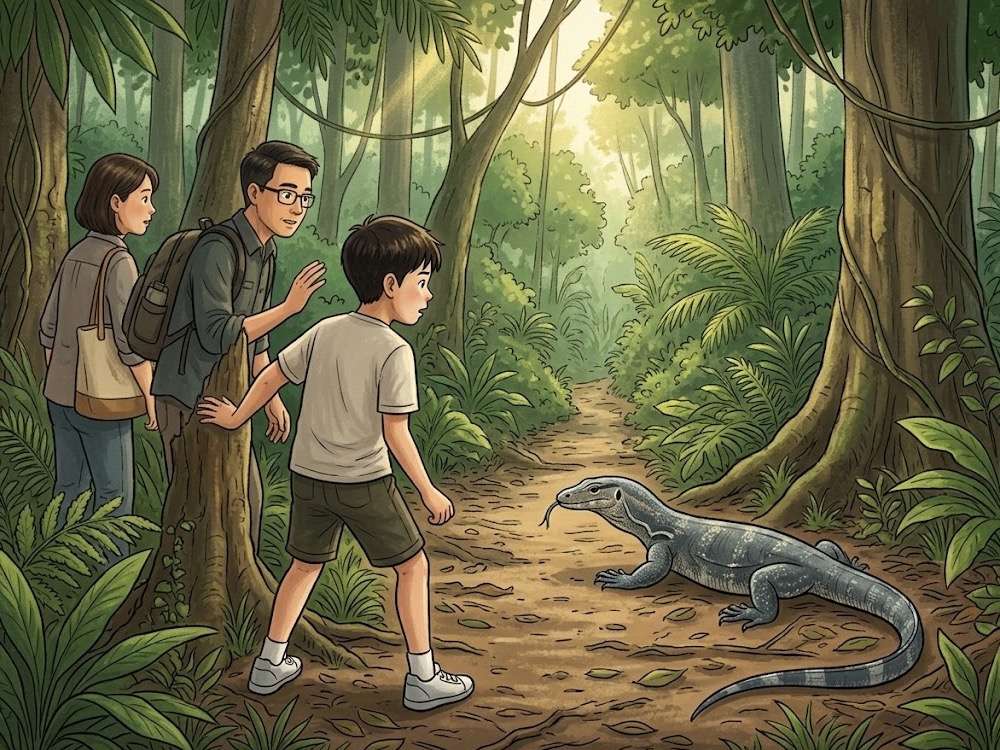
Dilan nearly walks into him. He looks up, ready to ask what is wrong, and then he sees it.
The monitor lizard lies across the path like a fallen log. It is longer than Dilan’s arm, maybe longer than his whole body, and its scales are the colour of wet slate. Its tongue flicks out, thin and forked, tasting the air. Its eyes are black beads set in a heavy skull, and they are looking directly at him.
Dilan freezes. His breath stops somewhere in his chest and will not move. The lizard does not move either. It simply watches, its sides rising and falling with a patience that feels ancient and absolute.
“Dilan.” Isaac’s voice is low, steady. “Stay still.”
Dilan cannot move even if he wants to. His legs have turned to stone. His heart is beating so hard he can feel it in his temples, in his fingertips, in the soles of his feet. The lizard’s tail twitches. Its claws, curved and grey, grip the dirt.
And then, somewhere in the frozen centre of his fear, a thought surfaces. Sensei Lim’s voice, calm and certain: Your body knows what to do. Let it.
Dilan breathes in. The air goes all the way down, past the knot in his chest, past the stone in his legs. He finds his stance without thinking about it. His feet plant themselves shoulder-width apart. His knees soften. His weight settles low and solid, the way it did on the dojo floor after the tenth repetition, the twentieth, when the movement stopped being something he had to remember and became something his body simply knew.
The lizard tilts its head. Dilan does not flinch. He holds the stance and breathes again, slower this time, and the fear does not vanish but it changes shape. It becomes something he can stand beside instead of something that stands on top of him.
The lizard blinks. Then it turns, unhurried, and slides off the path into the undergrowth. The ferns shiver where it passes and go still.
Dilan lets out the breath. His legs wobble. He puts a hand on a tree trunk to steady himself, and the bark is rough and real under his palm.
“That was a Malayan water monitor,” Isaac says. He is looking at Dilan with an expression Dilan has not seen before. Not pride, exactly. Something quieter. “They are not dangerous if you don’t threaten them.”
“I know,” Dilan says. He did not know. But he stood his ground anyway, and that feels like a different kind of knowing.
They walk on. The trail levels out and the trees open up, and suddenly there is sky again, wide and pale blue. Bev catches up and squeezes Dilan’s shoulder. She does not say anything, but the squeeze says enough.
At the lookout point, a wooden platform juts out over the slope. Dilan walks to the railing and looks out. The view stretches for miles. Green hills roll away into a haze of distance, and beyond them, tiny and distant, he can see the grey blocks of the city where his flat is, where his school is, where his tablet lies face-down on his bed. From up here, it all looks small. Manageable.
Isaac comes to stand beside him. He rests his forearms on the railing and stares out at the same view. For a long moment, neither of them speaks.
“When I was younger,” Isaac says, “I spent a lot of time looking at screens.”
Dilan turns his head. His father’s face is calm, but his hands are folded together on the railing, the knuckles pressed white for just a second before he loosens them.
“I was working long hours,” Isaac continues. “Drafting projects that never seemed to end. I came home tired and I sat in front of a screen because it was easier than talking. Easier than looking at the people I loved and admitting I did not know how to be present for them.”
Dilan does not know what to say. He has never heard his father talk like this. The words feel like stones being lifted one by one from a pocket Isaac has carried for a long time.
“You drew pictures,” Isaac says. “When you were smaller. You used to leave them on my desk. I looked at them, but I never said anything. I was too tired. Too wrapped up in my own fog.” He pauses. “I am sorry for that.”
Dilan’s throat tightens. He remembers the drawings. A shark with too many teeth. A house with a door that took up the whole front wall. He had stopped leaving them on the desk after a while. He had stopped drawing them at all.
“Why are you telling me this?” Dilan asks. His voice comes out smaller than he means it to.
Isaac turns to look at him. “Because you deserve to know that I understand. Not all of it. But some of it. The part where the screen feels safer than the world.”
Bev has come up behind them. She does not interrupt. She stands a few steps back, her arms crossed, her eyes moving between Dilan and Isaac with something soft in them.
Dilan looks down at his hands on the railing. They are steady now. The tremor is gone.
“I thought you were going to take the tablet away,” he says. “Punish me.”
“We thought about it,” Isaac says. “But punishment would not teach you what we want you to learn. Your mother and I… we are trying to find a different way. A way that works for all three of us.” He gestures at the hills, the sky, the trail behind them. “This is part of it. The dojo was part of it. The pool was part of it. We are trying to build something together. Something grounded.”
Dilan lets the word settle. Grounded. Like his stance on the trail. Like his feet on the dojo floor. Like the rough bark under his palm.
“Okay,” he says.
Bev steps forward and wraps an arm around his shoulders. She smells like sunscreen and the faint citrus of the taxi’s lemon cleaner. “We’re figuring it out too, you know. None of us have a manual.”
Dilan leans into her side. Just a little. Just enough to feel the warmth of her arm through his shirt.
The wind picks up, rustling the canopy below them. A mynah bird lands on the railing a few feet away, cocks its head, and flies off again. Dilan watches it go and feels something shift inside him. Not a big shift. Not an earthquake. Just a small loosening, like a knot that has been pulled one loop free.
He looks out at the green hills and the distant city and thinks about the tablet on his bed. It is still there. It will be there when he gets home. But right now, standing on a wooden platform with the wind in his face and his parents on either side, it does not feel like the only safe place left.
It feels like a screen. Just a screen. And the world, wide and green and full of monitor lizards, feels like something he might want to keep looking at.