
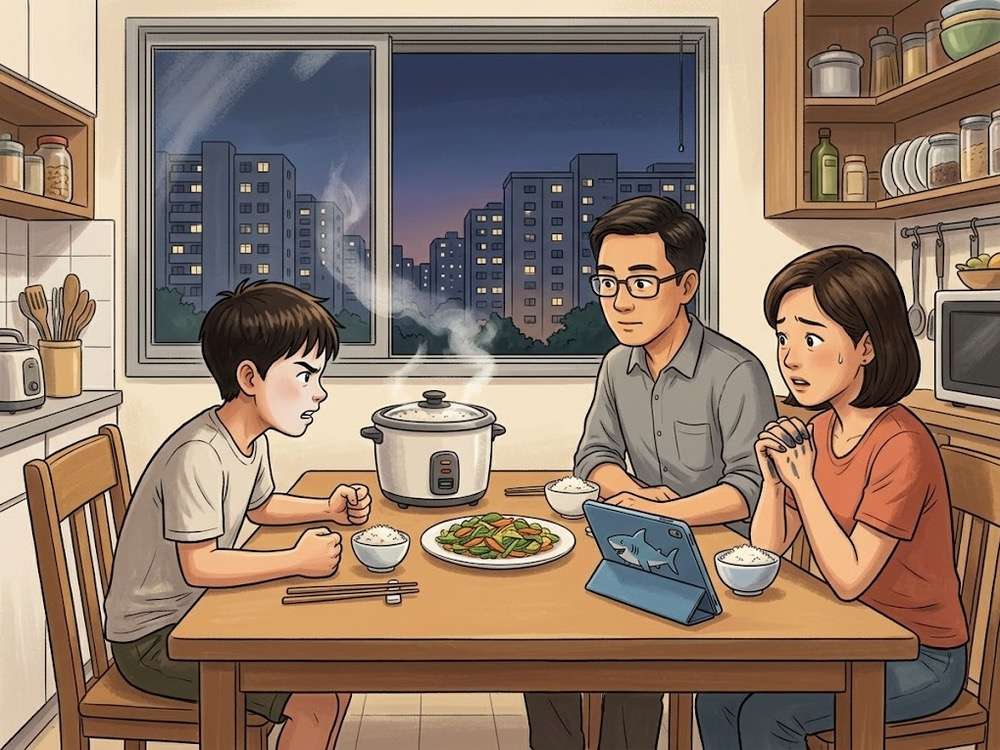
The steam from the rice cooker fogs a corner of the kitchen window. Dilan Tan sits at the dinner table with his tablet propped against the napkin holder, its screen casting a pale blue glow across his face. His thumbs move in quick, practiced taps. On the screen, a small character in a green hoodie jumps from platform to platform, collecting coins that chime with each pickup.
“Dilan.” His mother’s voice comes from the stove. “Can you put that away? Dinner’s almost ready.”
He doesn’t look up. The character misses a jump and falls into a pit of pixelated water. Dilan’s thumb jabs the restart button. The music loops.
Bev Tan carries a plate of stir-fried vegetables to the table. She sets it down beside Dilan’s elbow and rests her hand on the back of his chair. Her fingers are smudged with ink, she’s been working on a new illustration all afternoon, a spread for a children’s book about a fox who learns to share. She leans closer, and Dilan catches the faint scent of her hand soap, something with lemon.
“I was thinking,” she says, “we could try that paper-mache project this weekend. The one with the balloons? We still have all the newspaper from last month.”
Dilan’s character jumps again. A coin chimes. “Maybe.”
“We could make planets. You used to love the solar system.”
“I know.” His voice is flat, a door closing.
Bev’s hand slips off the chair. She exchanges a glance with Isaac, who sits at the other end of the table, his own hands folded in front of him. Isaac Tan is a man who moves slowly, as if every gesture has been considered and then considered again. He wears a plain grey shirt with a pen clipped to the collar, and his glasses sit low on his nose. He watches Dilan’s hands. The boy’s fingers shake slightly between taps, a tremor that doesn’t stop even when the game pauses for a loading screen.
The rice cooker clicks. Bev turns back to the counter.
Isaac says nothing. He watches the tablet. He watches the way Dilan’s shoulders curl inward, the way his whole body tilts toward the screen like a plant bending toward the only light in a dark room. The window behind Dilan shows the evening sky, a dull orange fading into grey above the HDB blocks across the street. A few lights blink on in other flats.
Bev brings the rice to the table. She spoons some onto Dilan’s plate, then Isaac’s, then her own. The vegetables steam. Dilan doesn’t reach for his chopsticks.
“Dilan,” Isaac says. His voice is quiet but clear, the kind of voice that doesn’t need volume to carry weight. “Put the tablet down now. It’s time to eat.”
Dilan’s thumbs keep moving. Jump. Coin. Jump. Coin.
“Dilan.”
“I’m almost done.”
Isaac reaches across the table. His movement is slow, deliberate, the same way he reaches for his drafting tools at work, never snatching, always giving the object time to meet his hand. His fingers close around the top edge of the tablet.
Dilan’s grip tightens. For a half-second, the tablet doesn’t move. Then Isaac lifts it gently, and the screen tilts away from Dilan’s face, and the blue glow slides off his cheeks and leaves them pale.
“No.” Dilan’s voice comes out thin. “No, I wasn’t done. Give it back.”
“You can have it after dinner.”
“I wasn’t done!” Dilan’s chair scrapes back. His hands are empty now, and they curl into fists on the tabletop, knuckles pressing into the wood. The tremor is worse. “Why do you guys always have to ruin everything?!”
The words crack in the middle. His voice splinters, and for a moment he looks as surprised by the sound as his parents are. The kitchen goes quiet. A motorcycle passes on the street below, its engine fading into the distance.
Isaac sets the tablet down beside his own plate, screen facing the ceiling. The little character in the green hoodie stands motionless on a platform, waiting for a command that won’t come. Bev’s hand hovers near Dilan’s shoulder but doesn’t land. She pulls it back and folds her arms instead, tucking her inky fingers into her elbows.
Dilan’s chest rises and falls too fast. He stares at his empty hands. The chopsticks lie untouched beside his plate. A curl of steam rises from the rice and vanishes.
“Okay,” Bev says. Her voice is warm but careful, the way someone speaks to a startled animal. “Okay, sweetheart. We’re not trying to ruin anything.”
Isaac doesn’t speak. He looks at Dilan’s face, at the red creeping up his son’s neck, at the way his jaw is clenched so hard the muscles stand out. Then he looks at the tablet. The screen dims, then brightens again as a notification slides into view, someone has sent a message in the game’s chat window. A name Dilan knows. A name that makes his hand twitch toward the device before he stops himself.
“I just wanted to finish the level,” Dilan says. The anger is gone now, replaced by something smaller. His voice is barely above a whisper. “It’s a timed event. Everyone’s doing it.”
“Who’s everyone?” Isaac asks.
Dilan doesn’t answer. He picks up his chopsticks and pokes at a piece of broccoli. The vegetable rolls to the edge of his plate and stops.
Bev sits down. She spoons more vegetables onto Dilan’s plate, as if more food might fill whatever gap the tablet left behind. “We can talk about the paper-mache later,” she says. “No rush.”
The family eats in silence. The only sounds are the click of chopsticks against ceramic and the distant hum of the refrigerator. Outside, the sky deepens from grey to a soft, dark blue. More lights blink on in the flats across the street, neat rows of yellow squares stacked one on top of another. The tablet lies beside Isaac’s plate, its screen slowly dimming until it goes black.
Dilan chews his rice without tasting it. His eyes keep drifting to the dark screen, and each time they do, his chopsticks pause. He thinks about the timed event. He thinks about the chat message, still unread. He thinks about the person who sent it, and whether they’ll still be online when dinner is over, and whether they’ll wonder where he went.
Isaac picks up the tablet. He turns it over in his hands, studying the case, a bright blue cover with a cartoon shark printed on it, its mouth open in a grin. Dilan chose it two years ago at a shop in Tampines Mall, back when the tablet was a shared family device for watching videos on Sunday afternoons. Now the edges are worn soft from use.
He sets it down again without a word.
Bev catches Isaac’s eye across the table. Neither of them speaks, but something passes between them, a small nod, a slight lift of her eyebrows. Isaac folds his hands again and watches his son push rice around his plate.
The ceiling light buzzes softly. The steam has stopped rising from the food.
Dilan finishes his dinner in small, mechanical bites. When his plate is empty, he sets his chopsticks down and waits. He doesn’t ask for the tablet. He doesn’t look at his parents. He stares at the window, at the reflection of their kitchen floating against the darkening sky, three figures at a table, a plate of cooling vegetables, a blue case with a shark on it lying still beside a folded napkin.
The reflection wavers as another light clicks on somewhere outside, and for a moment Dilan can’t tell which version of the room is real.