


Protecting my hearing has become a serious priority as I get older. Once you lose high-frequency sensitivity or develop persistent ringing in your ears, no amount of money or medical intervention can fully restore what is gone. For years, this concern kept me away from traditional in-ear buds that seal off the ear canal and fire sound waves directly at the eardrum, as well as heavy on-ear clamp headphones that trap heat and cause fatigue after an hour.
That is why we rely heavily on the Shokz OpenComm2 and the OpenComm2 UC with its wireless adapter at our office. Bone conduction audio changed how I approach long workdays. By sending sound vibrations through the cheekbones directly to the inner ear, the ear canal remains completely open and breathable. I stay aware of what is happening around me in the room, my ears never feel blocked or sweaty, and I can take back-to-back calls without feeling acoustic strain.
What Works Well on the OpenComm2 and Where It Hits a Wall
The OpenComm2 earned its place on my desk for good reason. It is remarkably light, holds a charge across long stretches of meetings, and avoids the vice-like head pressure of conventional office headsets. Most of all, I appreciate its physical, rotatable boom microphone. Too many modern headsets rely on tiny hidden microphones tucked inside the earcup or collar. Those timid, recessed mics pick up every rustle of clothing and room echo, forcing the other person to ask you to repeat yourself. Having an adjustable boom arm positioned near the corner of my mouth makes a clear difference in vocal pickup.
Still, the OpenComm2 has one structural limitation that bugs me outside strict desk hours. Because it uses a rigid wraparound titanium band behind the neck, you can only wear it upright. The moment you lean back against a high headrest, recline on a sofa, or lie flat on a bed or floor to listen to a podcast or unwind with music, that rear loop pushes forward and shifts the transducers off your cheekbones. It simply does not work when lying down.
Over-the-Head Shokz OpenMeet2 and OpenMeet2 UC
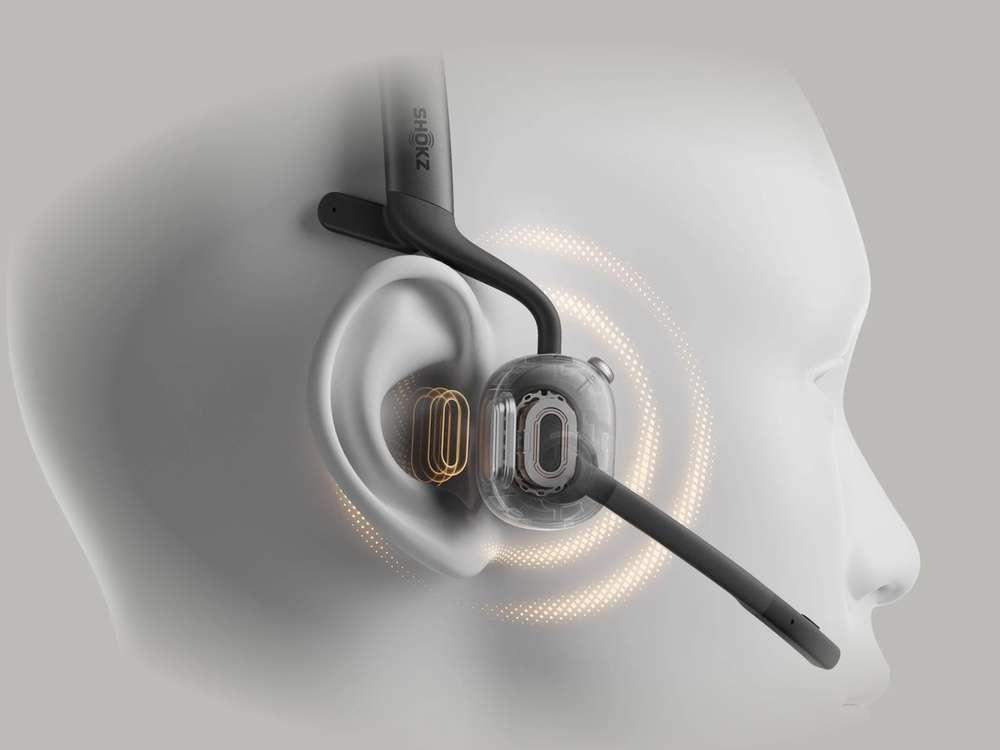
Shokz addressed that exact geometry problem with the Shokz OpenMeet2 UC and the standard OpenMeet2. Launched in July 2026, this model replaces the behind-the-neck collar with an over-the-head band. Because the top of your head bears the frame instead of the back of your neck, you can sit upright at a desk, lean back in a chair, or lie flat on your back without anything digging into your skull or knocking the transducers out of alignment.
It is larger and bulkier than the OpenComm2, and you cannot tuck it into a shirt pocket. Even so, at roughly 77.9 grams, it remains far lighter than typical over-ear studio or call-center cans. Shokz uses a free-form titanium-alloy core wrapped in skin-friendly silicone, paired with adaptive memory foam and protein leather cushions along the inward-contoured GlideFit frame. That design distributes tension evenly and leaves plenty of clearance for eyeglasses, earrings, or behind-the-ear hearing aids.
Built for Demanding Workdays
For serious office and hybrid work, the UC edition stands out because it bundles the Loop120 wireless adapter in either USB-C or USB-A formats alongside Bluetooth 6.0 connectivity. While standard Bluetooth works fine on a phone, a dedicated wireless dongle gives you plug-and-play stability on Windows and Mac computers, unlocks the Shokz Connect desktop software, and brings official Zoom and Webex certification.
The boom arm retains the tactile control I value. You can mute yourself immediately by flipping the boom arm upward or pressing the dedicated mute button, while an integrated red busy light signals to colleagues that you are live on a call. Inside, the Qualcomm Snapdragon S3 Gen 1 Sound Platform drives a dual-microphone system with AI noise cancellation that filters out up to 99.4 percent of ambient chatter, keyboard clatter, and café noise. A rotary dial handles volume adjustments cleanly without fumbling for tiny buttons.
Versatile Enough for Play and Rest
Work is only part of the equation. Where the OpenMeet2 becomes truly appealing as an everyday companion is how well it transitions into leisure and downtime. Shokz DualPitch technology pairs a PremiumPitch 3.0 bone conduction core with an 11 mm by 21 mm air-conduction driver powered by four amplifiers, while LeakSlayer 3.0 vibration control keeps sound private so people nearby do not overhear your audio.
That hybrid acoustic setup gives music, films, and audiobooks far fuller bass and cleaner highs than older bone conduction headsets could manage. With up to 16 hours of audio playback, up to 12 hours of talk time, and a five-minute quick charge that adds two hours of calling, battery anxiety rarely enters the picture. Multipoint pairing lets you stay connected to two devices at once with an eight-device memory, so jumping from a laptop call to a tablet movie or phone playlist happens cleanly.
Most importantly, when the workday ends and I want to lie down on the floor to stretch or rest on the bed with an audiobook, the over-the-head band stays comfortable and secure while keeping my ears open and unpressured. It trades pocket-sized minimalism for genuine around-the-clock versatility, making it a compelling upgrade for anyone who cares about long-term hearing health without sacrificing comfort across work, play, and rest.
###